
Home » Uncategorized (Page 4)
Category Archives: Uncategorized
The Stress and Rubber Band Analogy
By Dr. Valerie A. Bussell
 As a health psychologist I am very interested in how people cope with the various stressors of our very demanding and busy lives. In regards to how we adapt to stress, I often use the analogy of a rubber band.
In my analogy, all people are equipped with various weights and sizes of a single stress absorbing rubber band. Our ability to adapt at any given time depends on the width, length and strength of this band -as a measure of how much load we can bear.
Sometimes, we have great resiliency and our stress rubber bands are thick and long with great elasticity and endurance for all the stressors of life. At other times our rubber bands are thin and fragile and unable to bear much at all.
Using this analogy, the pull or demands on our “stress” rubber band can come from many directions and our stress endurance would be at what point the rubber band might break from too much stress. The breaking of our band could result in a variety of dis-“ease” – of the mind, the body, and the soul.
External stressors like the demands of our job and relationships are stretching our stress endurance band from one direction while internal pressures like personal ambitions or goals (our “shoulds”) are simultaneously pulling from the other direction. If you have great demands in all directions – the greater likelihood that the band will break and various forms of dis-ease will result.
Now in keeping with this analogy, our stress-enduring rubber bands also have a point that they are at rest – like those rubber bands stored in the kitchen junk drawer. However, unlike the real rubber bands our stress rubber bands are capable of remarkable renewal while at rest.
The usefulness of this analogy is in the importance of self-analyses from time to time to determine the state of our stress-related rubber band while also contemplating the load of stress that we are attempting to bear. Are we attempting to bear more stress than our resources are capable of enduring?
Another benefit of this analogy is to understand the importance of rest and renewal for the state of our stress rubber band and the consequences for our health.
- What is the current burden of stress in your life? Is it within reasonable limits? What can you do to reduce any extraordinary demands?
- What is the condition of your rubber band in response to internal and external stress? Is it approaching its limit and therefore putting you at risk for disease?
- Are you allowing your rubber band to rest and fortify itself with sleep, worship, and play?
In these busy times, we are demanding much from ourselves while our jobs and relationships are also requiring more and more. In terms of emotional and physical health, it is important that we take stock of our personal resources for stress (the current state of our rubber band) and also take time for valuable rest and renewal.
Exodus 33:14
“My presence will go with you, and I will give you rest.”
love is action
By Dr. Reifkohl
“By this shall all men know that ye are my disciples, if ye have love one to another.” John 13:35
Have you demonstrated your love for someone today? Hearing the words is heartwarming, but it is said that actions speak louder than words. Receiving demonstrations of love is far more believable than just the words.
Have you ever witnessed someone being bullied? October is National Bullying Prevention Month. Research has shown that the victims of bullying and the bullies themselves can experience psychiatric problems in childhood that can even extend into adulthood. In some cases, bullying can get so bad that victims choose to take their own lives. Bullying is a serious issue but it can be prevented. It is up to everyone (educators, parents, and the community) to use their strengths and skills to prevent bullying.
www.stopbullying.gov provides a definition, shares warning signs and symptoms as well as specific ways to prevent and to respond. It is everyone’s responsibility to help stop it.
The following is a story about a little boy who wrote a letter to Santa because his sister was being bullied… we can learn a lot from children…
Brain Lady
By Darby Hawley
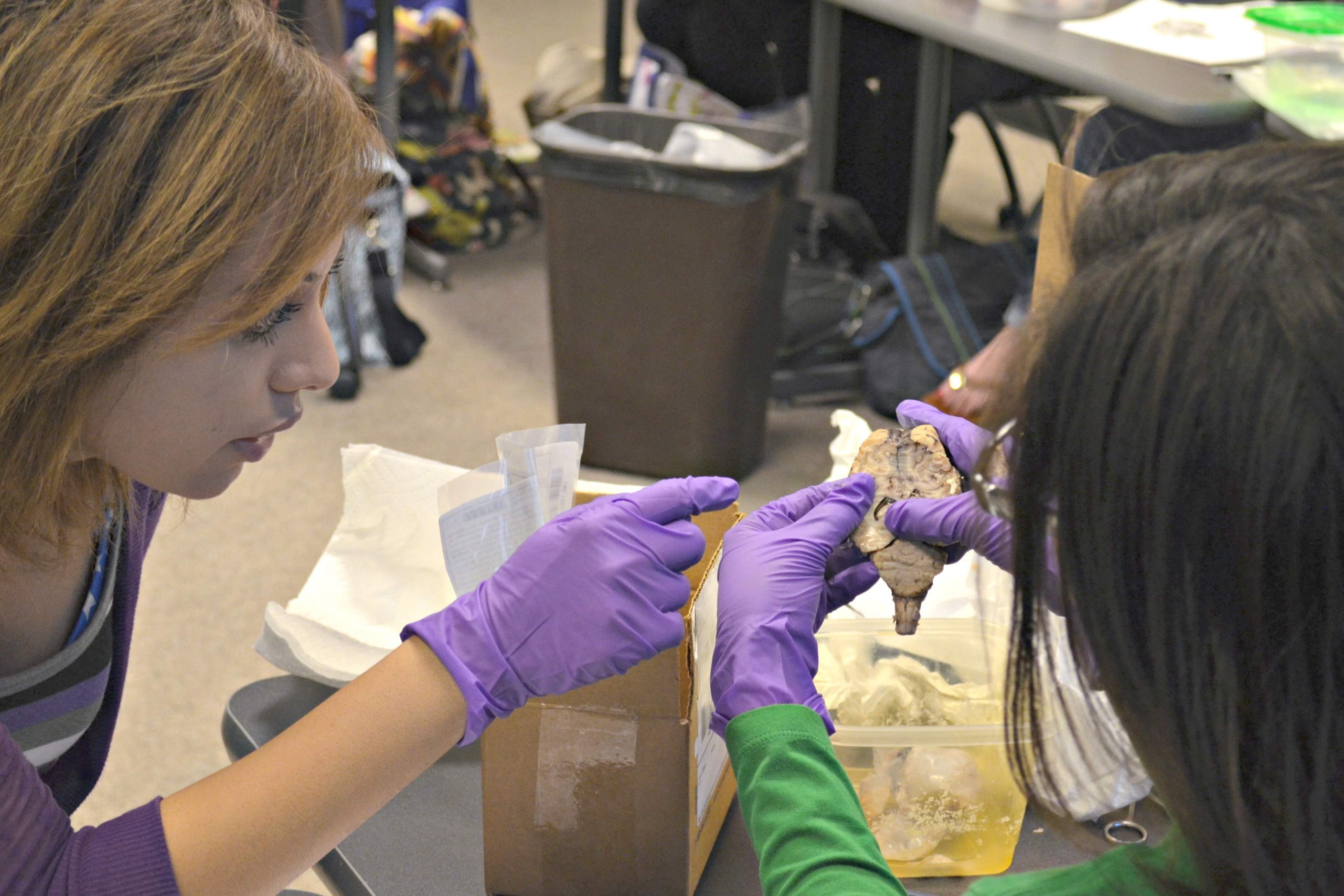
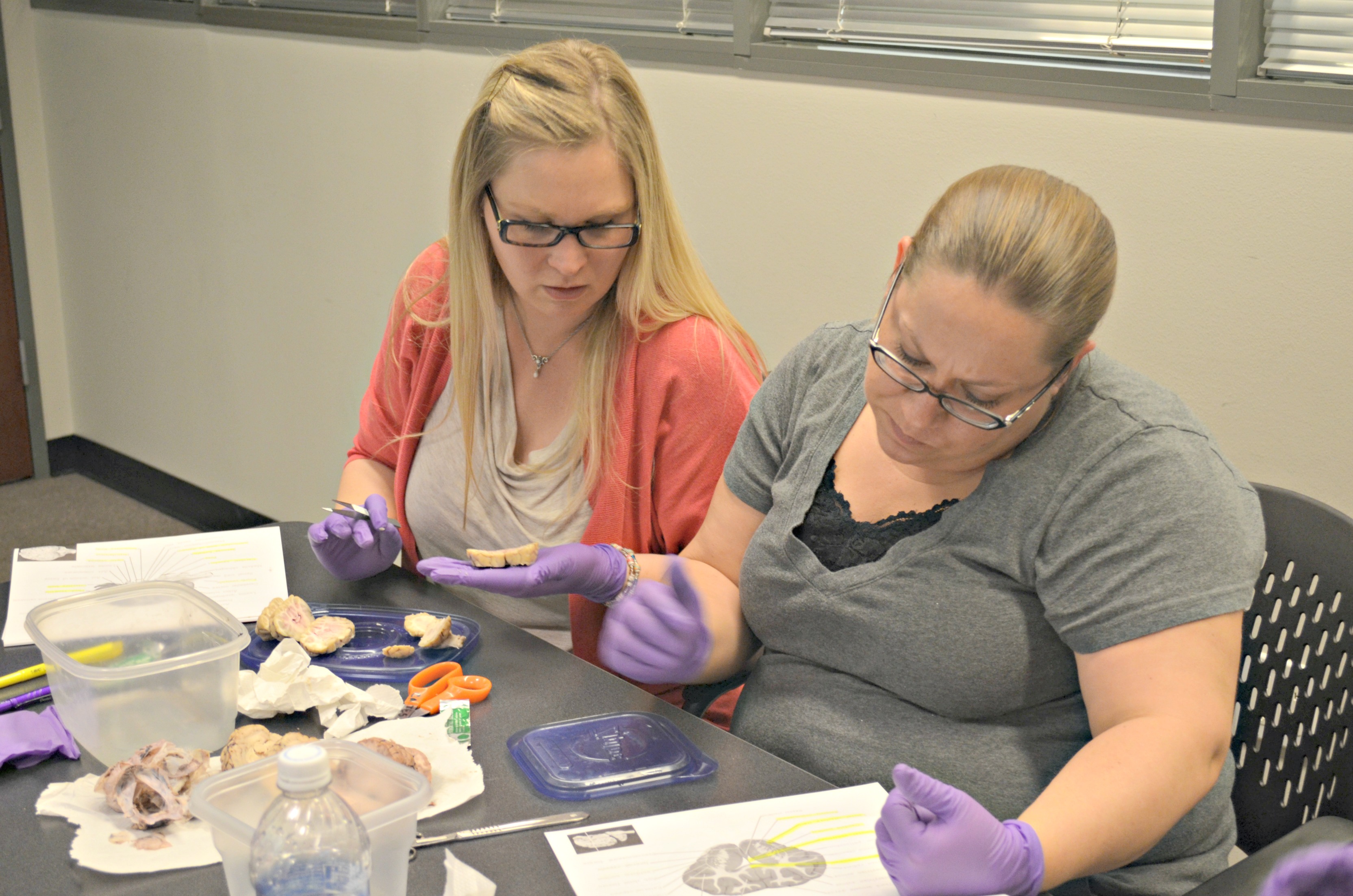
Among my family, friends, and colleagues I am known as The Brain Lady. This nick name does not bother me at all; in fact, I find it quite honorable, yet humbling. I remember the day I fell in love with the amazing brain; I was completely captivated. The brain is a remarkable structure that God has given us that continually has me in awe; it is such a powerful mystery. At the content-specific level in both of my graduate and undergraduate Physiological Psychology courses, I want my students to understand the bigger picture of psychology–that science does not just reside in the classroom or in the laboratory. I want my scientific work and passion for the brain to enhance people’s daily experiences and I want my students to see how salient (personal) science really is. When science becomes personal, students develop a sense of belonging to the scientific community, thereby making course work more interesting and enjoyable. Through the lens of psychology, contextualizing material about the brain in such ways leads to greater actual integration and recollection. By demonstrating how relevant science is to our daily lives, it is my hope to motivate my students to develop an appreciation for the strength and power that the brain has over the entire body while making complex subjects understandable. So if this gives me the title of Brain Lady, I will gladly take it 🙂
Last spring in my graduate physiological course, each student dissected a sheep brain. The dissection was a great opportunity for students to see all of the structures we learned about throughout the semester. Students were able to identify and locate where structures were within the brain and in relation to each other. Not only did this dissection challenge help students to have a hands-on experience in the classroom that would facilitate learning for assessment, but it also helped to make science tangible and personal.




Science, the truth, and the Truth
By Dr. Stephanie Ellis
Recently, Discover Magazine had a blog post titled “’Is Psychology a Science?’ Is the Wrong Question.” (you can read it here: http://blogs.discovermagazine.com/neuroskeptic/) Despite being skeptical about psychology (one of the loves of my heart!), it makes some very good points, chief among them…
“There is no special ‘scientific method’ that sets ‘science’ apart. Different branches of science use different methods to uncover the truth.
Theoretical physics, organic chemistry, and evolutionary biology have nothing in common beyond the fact that they study something. And nor should they.”
But it does something even more remarkable – it begins talking about the search for “truth.” As Christians in higher education, this is a particularly important issue for us. We are in the business of finding and teaching truth, and of understanding it in the light of the Truth of God. The post makes one more point –
“a better question to ask of psychology is: “is it true?” – or rather “how true is it?” Few fields are 100% true or false.”
If you’re familiar with inferential statistics, you’ll know what I mean when I say that truth as we know it is about 95% likely not to be random chance. Rational truth (determining truth through logical argument) starts out simple and clear and progressively gets more convoluted as more data appears, until someone resets the whole mess with a paradigm shift. And empirical truth (learning through experiencing with the senses) is by definition filtered through the nervous system, giving rise to the creepy questions like “Is anything really true, or are we in the Matrix?”
But underneath is the idea that there is a REAL truth about science. There really ARE fundamental laws of physics operating in the universe, even if we have to keep revising how we understand them as we see farther into the universe. There really ARE basic building blocks to life, even if we have to give new names to “new” particles as we dig deeper and uncover them. There really IS something behind the experience of consciousness, even though we have barely a clue what it might be.
The Truth is 100% true and it’s been there all along. It’s not 100% well-translated. It’s not 100% well-understood. It’s certainly not 100% agreed upon by all seekers. We just have to keep using all the methods we can to uncover it, and remember that the Lord is the Author of all that’s true in science, and beyond.
This is the day the Lord has made!
This is the day that the Lord has made.
By: Dr. Sharon A. Lewis, Associate Professor Reading Education
Yesterday I looked out of the restaurant window and saw the amazing double rainbow. When I tried to take a picture of that double rainbow, I somehow had it on video. Being technology challenged, I didn’t know how to capture just one slide for a picture. So I had to find this one on the internet. That doesn’t change my thoughts though at seeing this amazing sight. The first thought I had was, “This is the day that the Lord has made. I will rejoice and be glad in it.” Sometimes we sing these words but don’t really let them sink in. As Dr. Sloan said in Opening Convocation, yesterday is gone and we must put our efforts into today. God has given us this day and we need to rejoice about all the good things it will bring even in (and maybe especially in) times that are challenging. Each and every day is a gift from God.
Think about the technical aspects of a day. It is one rotation of the earth. It has a sunrise and a sunset. It lasts for 24 hours. Oh, what we can do with that time. Romans 1:12 tells us that we encourage each other in faith. Reach out to a friend or classmate and give them a word of encouragement. It is a small effort, but has a huge payoff. You may not see the payoff, but it is there.
Daniel Tomasulo, Ph.D. tells of an incident in his life where he was angry about arrangements that he made for a presentation that got changed at the last minute and threatened to damage the entire presentation. He got into his car and literally screamed at the top of his lungs, because he was so frustrated. He recounts the incident like this:
I drove up to the toll booth and dug into his pocket to pay the toll. The tollbooth
person said, “There is no toll for you today, sir.”
“Don’t start with me,” I said in a huff. “Just take my money, please.”
“The car in front of you paid the toll. He said to tell you it was a random act of
kindness — and to have a nice day.”
“What?”
“It has never happened before. He actually gave me more than what your toll is and told me to apply any leftovers to the car behind you.”
“Really?”
“Really.” (D. Tomasulo, Ask the Therapist blog)
That person wasn’t there to see that his or her actions totally turn around an angry day into one of blessing.
Psalm 81:10 says that God will fill us and all we have to do is receive it and then do something with it. God used this unknown person to fill Dr. Tomasulo and change his day just as He can use you to change someone else’s day. Psalm 118: 24 reminds us that we are to rejoice in what the Lord has done this day. When you do something for someone else, it will come back to you. It may not be right away, but it will happen. You’ve heard the saying, “What goes around, comes around.”
Dr. Tomasulo had another lesson for us. He referred to a study by Dr. Martin Seligman from the University of Pennsylvania. Who, after years of studying depression, came up with an activity called, Three Blessings. ( http://www.buildingpersonalstrength.com/2010/09/dr-martin-seligman-three-blessings.html) “The task is simple enough. As your day comes to a close, allow yourself to think about three things that happened during the day that you are most happy about, and why you believe they happened. The outcome from doing this exercise is astonishing. Participants doing this exercise for one week increased happiness and decreased depressive symptoms for six months.” (D. Tomasulo, Ask the Therapist blog) Think what could happen if you did it every day.
Our world is often full of bad news. The issues in Syria, the killing of a visiting soccer player, the average American income has gone down $2300 this year, and it goes on. Amid all of that, God is there comforting us and blessing us.
Every day is a chance to do something. You can’t change yesterday and you don’t know what tomorrow holds, but you can rejoice in today. Each day is a gift from God and we want to use it well.
Alexander in Alexander and the Terrible, Horrible, No Good Day, Very Bad Day wanted to run away to Australia. That might seem like an answer, but a better response is to run to God. He will provide and comfort.
I challenge you to count your blessings tonight and to write them down each night for a week. What difference will it make for you? Remember that we can’t change unless we are humble enough to learn. How you view each day is up to you. Have a blessed day! ∞
An Old Dog Can Learn New Tricks

by Dr. Dawn Wilson, Associate Professor in Educational Technology
After over 20 years, I have just completed teaching my first few sections of an online course. I must admit, while initially skeptical of the whole idea, I find myself rather pleased at the outcome. At the same time, it helped me to shift some of my thinking about teaching and learning not only online but also in face-to-face contexts.
I teach courses that help educators learn how to integrate technology in the classroom. These teachers believe a lot in the face-to-face classroom. When I began this process, I was not sure if students could produce the same kinds of learning in an online course verses the face-to-face course. To be honest, I wasn’t sure I would like teaching online. I too love the face-to-face interactions I get to have with students as they are learning something new. You know, that aha moment! I hated to miss out on those moments. Additionally, in my face-to-face courses (technology integration mostly), there are often levels of remediation that takes place as students navigate the use of new software and tools. I wasn’t sure how that would translate to an online environment.
It turns out, students were able to produce the same learning regardless of their environment. I also learned that in the online environment, the best part was to watch the students support each other’s learning. The online discussions and Q&A forums became places where students could be encouraged, challenged and supported by someone other than me in the classroom. This was awesome to read and watch in action. It was truly a powerful learning community focused on the topics of the week. By the end of each discussion I had heard comments from every class member (when was the last time that ever happened in a face-to-face-class). In addition, I was able to personally give feedback and comments about student products and contributions to the discussion each week to each class member (again, when was the last time that happened in a face-to-face class). I loved the fact that while I designed the instruction and created the learning environment, there were many voices in the instructional environment – not just mine. I learned new things along with my students as they explored topics in ways I had not thought about initially.
It was also fascinating to watch my graduate students begin to embrace the possibility and the benefits of online or blended or flipped instruction. They found the individualized feedback and time on task very valuable. In a world where we are all asked to differentiate, they found online learning itself to be differentiated (especially by pace) for the student. One student may need an hour to accomplish a task, while the next may need to rewatch or reread things several times before clearly understand the content. If the course is constructed well, students should also have a way to practice the content and demonstrate their learning in a variety of ways. Assessment should include not only multiple choice tests or quizzes, but also discussions, projects, presentations and exams.
Don’t get me wrong…I don’t have it completely figured out. I need to be more intentional about guiding and facilitating the level of the depth in the student postings. I need to make refinements in some of the rubrics to more clearly delineate good from great learning artifacts. I need to find better ways to manage all of this work – individualized feedback, requires extra time, and I haven’t mastered a manageable system.
What I am most encouraged to find that graduate students now have many options available for them as they choose to extend and expand their learning. These choices will only grow as we advance our vision of online learning. As I have watched the Khan Academy model grown in acceptance, I find I am even more encouraged about how these models can enhance even our K12 and undergraduate student experiences.
In Disrupting Class Christensen suggests that computer assisted learning will revolutionize teaching and learning. Student will sit in front of a computer and between the program and the computer and the student, learning progress will be made. My recent experiences have me looking for ways to build a learning community for teaching and learning. We are challenged to dig deeper in a learning community, and I found my role as teacher/facilitator in the online class different. I spent much more time thinking about, planning and preparation for the learning. Then once the class began, I spent more time individualizing instruction. Students functioned, not as an island, but within an online learning community constantly challenging each other. This teaching and learning model is a win-win scenario for our students. I can’t wait to do it all again!
He Did It!
by David Keith Moss, Assistant Director of Compliance HBU
On this Memorial Day let’s remember the men and women who fought and died in service to protect our country and to continue to provide us the freedom we have today! We often times take that freedom for granted and more times if we take the time to recognize the freedom, we don’t acknowledge the people who suffered and died to provide us that freedom! Please take a moment today to sit back and thank God for those military men and women who gave their lives for us, to provide the freedoms we enjoy today. One of those freedoms is that of reading our Bibles and loving the Lord our God out loud!
What do I mean by loving God out loud? I mean to have the freedom to carry a Bible, to talk openly about your belief and to speak boldly about your faith in Jesus Christ as your Savior. We have that freedom, but do we evoke the right to speak about it openly? I am so guilty of shying away from opportunities to claim Him to others and actually am ashamed that sometimes I get hesitant when I say God bless to a cashier or waiter for fear they will reject or that I will hurt their feelings. Why is that? Because I go on my own power and I allow self to enter into the equation of being rejected. What I need to hang on to and to carry with me is the power of the Holy Spirit and through his power and love I can overcome that fear and fight off the thoughts of rejection and boldly claim Jesus Christ as my Lord.
My prayer is that each of us would take heed to God’s truth and listen to Christ’s words when he spoke them to the large crowd who was following him in Luke 14:25-35. What does it mean to follow Him? Jesus was telling the people, his followers, his disciples what the cost looked like, meant and the importance for each of them then and for us today, to weigh those costs by looking closely at what those costs would amount to. He uses the example of how a builder would look at a costs of building a tower to find out if he had enough to complete the project. He is asking us to do the same when it comes to following him. Take the time, do your homework and observe and study what it would means and what it takes to be a Christ follower. Jesus was encouraging those who were following him to either go deep or go back! Are we allowed to be a minimum requirement Christian? Or does He expect us to be a maximum commitment disciple?
My question to us is: have we weighed the costs and is our desire to be a Christ follower? Can we follow and remain a minimum requirement Christian? My study shows me we don’t have the choice and if we claim to be a Christian the only way is to become a maximum commitment disciple!
HE DID IT!
Let’s Do IT!
Your friend and fellow follower of Christ!
Let’s go and make a difference both globally as well as locally, by loving people where they are and loving them till they ask why!
Can You Be Spiritual and Not Religious?
James 1:27. Religion that God our Father accepts as pure and faultless is this: to look after orphans and widows in their distress and to keep oneself from being polluted by the world.
1 Corinthians 10:3-5. They all ate the same spiritual food 4 and drank the same spiritual drink; for they drank from the spiritual rock that accompanied them, and that rock was Christ.
by Dr. Tom Kennedy
“I’m spiritual but not religious.” I hear and read this many times. What does this phrase mean? For people who do research in the area of religion and spirituality, however, separating the two is very difficult, if not impossible. For millennia the word religious had about the same meaning as the word spiritual.
Today religion is popularly labeled as the doctrine and beliefs of a group. Spirituality, on the other hand, is individualized and only concerns itself with the relationship of that person to the sacred or transcendent (Koenig, 2005, pp. 44-45). Yet current research finds that at least 74% of people do not make a distinction between religion and spirituality. How then can we best define the relationship between the two?
In my young adult novel, My First Week in Heaven, I gave an analogy of that relationship. Let’s assume we have an imaginary child who represents the relationship between religion and spirituality. The skin, muscles, heart, and other tissues represent the child’s spirituality. The bones represent his/her religion.
First, correct religion, like bones, provides the proper structure for spirituality. Spirituality grows in distorted ways without religion. Imagine reaching over and grabbing the child’s head. Then imagine lifting up the skeleton out of the imaginary child. What would happen? Spirituality would collapse to the floor,
Secondly, religion, like bones, also provides much of the immune system for spirituality. It helps to fight toxic influences that may corrupt one’s spirituality. Two of the most toxic influences are the individual’s own selfishness and the willingness to let other people control one’s spirituality. Of course, if religion itself becomes corrupt, one’s spirituality also becomes corrupt.
Many people think of spirituality as perfect and incorruptible. Unfortunately, that is not true. Non-religious spirituality emphasizes special experiences, something you feel. If there are no feelings to this kind of spirituality, people would not pursue it. I have heard of many strange experiences that were labeled ‘spiritual’ just because there was a burst of pleasant feeling involved.
Perhaps we need to look at who has the right to define religion, spirituality and their relationship. In I Corinthians 10:4 spirituality is defined as a relationship with Jesus. Religion in the Bible is a catalyst for that relationship. The Bible is equally clear that religion and spirituality are not defined by us. They are only defined by God. He didn’t ask advice about spirituality and religion at the beginning of humanity and he doesn’t ask us now. He has already figured it out.
Jesus died on the cross to make God’s religion and spirituality alive, dynamic and interactive with each other. There is no option to delete one or the other. So, can you be spiritual and not religious? I would say, yes. But this kind of spirituality is weak and directionless, or worse, narcissistic. Jesus wanted us to have a vibrant faith that focuses on him and he wants us to use the teachings of the Bible to shape both our religion and our spiritual interactions with him and God.
That is just good psychology.
Koenig, H. G. (2005). Faith and mental health: Religious resources for healing. Philadelphia, PA: Templeton Press
Summer Vacation 101
Dr. Carol McGaughey
As everyone knows, summer vacation is a carry-over from the agrarian era when school children were needed during the summer months to assist on the family farm. In this digital age when school children are taken to farms on fieldtrips or play Farmville to learn about farms, this is certainly not a reason to have a summer vacation, yet the break from school still persists. Why?
Well, first the mythology of summer vacation needs to be examined more closely. According to historians at Old Sturbridge Village, a living history museum that recreates an 1830’s New England farming village, farm children attended school from December to March and from mid-May to August. Rural students were not in session in spring or fall so students could help with spring planting and the autumn harvest. Urban schools in the 1800’s were on an 11 month school year to provide a safe, affordable place for the children of immigrants to stay while their parents worked. These students had no summer vacation, despite the common belief that summer vacation is a legacy from the era of farming. So, how did having a vacation in the summer begin?
According to Professor Ken Gold of City University in New York, school reformers of the late 19th century instituted summer vacation for several reasons, none of which relate to agriculture. First, reformers wanted a standardized school year for the urban and rural communities. The rural essentially had two terms; summer and winter; while the urban schools ran all year with time off for holidays. The compromise was to remove the summer term with school in session the rest of the year except for important holidays. So, with otheravailable choices, why remove the summer term?
The wealthy families in urban areas vacationed during the summer, thus pupils were absent for long stretches of time. That was certainly positive for these children as the heat in urban school buildings without air conditioning was stifling causing many other children to stay out of school at that time as well. Additionally, doctors of the era actually thought it was medically unwise to confine students in a classroom year-round. They believed a break was needed. Finally, the summer months were a time for teachers to train as there were few colleges to attend for certification but an availability of summer teacher training.
Thus, the summer vacation was born. Over the years, it became entrenched in American culture, and the economy began to depend on the many facets that accompanied this extended break from school. Whatever the origin, college students, and their professors, look forward to a time to rest and recharge, to regenerate and re-invent, to remember and reflect.
To every thing there is a season, and a time to every purpose under heaven.
Ecclesiastes 3:1
Best Psychology for a Healthier Life: Go to Church
by Dr. Tom Kennedy
Hebrews 10:24-26 (NIV)
24 And let us consider how we may spur one another on toward love and good deeds, 25 not giving up meeting together, as some are in the habit of doing, but encouraging one another—and all the more as you see the Day approaching.
The best way to live longer, healthier, and happier is to avoid certain behaviors and increase other behaviors. Avoiding cigarettes, too much fatty food, drugs, and anxiety provoking situations are among the top things to avoid. We could easily brainstorm other items. Most of them are lifestyle choices that are called ‘risk taking’ in the research literature. Reducing risks to one’s mental and physical health increases one’s longevity and happiness.
What can you add to your life to increase the length and quality of it? You can exercise, eat more vegetables, marry (and stay that way), develop a group of supportive friends, and find meaning in your life. Did you know going to church regularly can improve your mental health and to a lesser extent your physical health? People who attend church at least once a week have, on average, healthier and happier lives than those who attend occasionally or not at all. Six decades of research has clearly shown this result.
Church attendance can give a person two healthy things to add to their life. As people settle into churches, most of them develop strong supportive relationships among the other members. During times of health and family stress these church friends pray for and encourage each other. Psychologists have realized for many years how powerful these relationships are and that there are very few organizations that can imitate the church’s ability to support its members.
What about bowling or soccer leagues? Can’t they substitute for church? Though different competitive activities can be ‘fun’ and provide a type of support group, church gives its members permission to share hurts, fears, and disappointments. Competition does not foster this kind of openness.
In addition worshipping at church is an expression of one’s reverence and gratitude to a God who demonstrates love, compassion, and sacrifice for us. The meaning we find in Jesus Christ tells us that the purpose for life is outside of ourselves. Our task is to focus on Him and we will find the meaning that we desperately seek and need. He leads us to invest ourselves in Him and into others. Isn’t it interesting that psychological research has shown that people who have a purpose in life derived from outside of themselves are happier and healthier than the self-centered.
I can’t guarantee if you will be happier and healthier if you attend church regularly. Psychological research only shows that on average people who attend church once a week or more are healthier and happier. But psychology indicates that two of the best, if not the best, behaviors to increase in your life are to give yourself to God and frequently go to His church.
It’s the healthy thing to do.
References: Koenig, H. G. (2008). Medicine, Religion, and Health: Where Science and Spirituality Meet.
 Thinking Allowed